
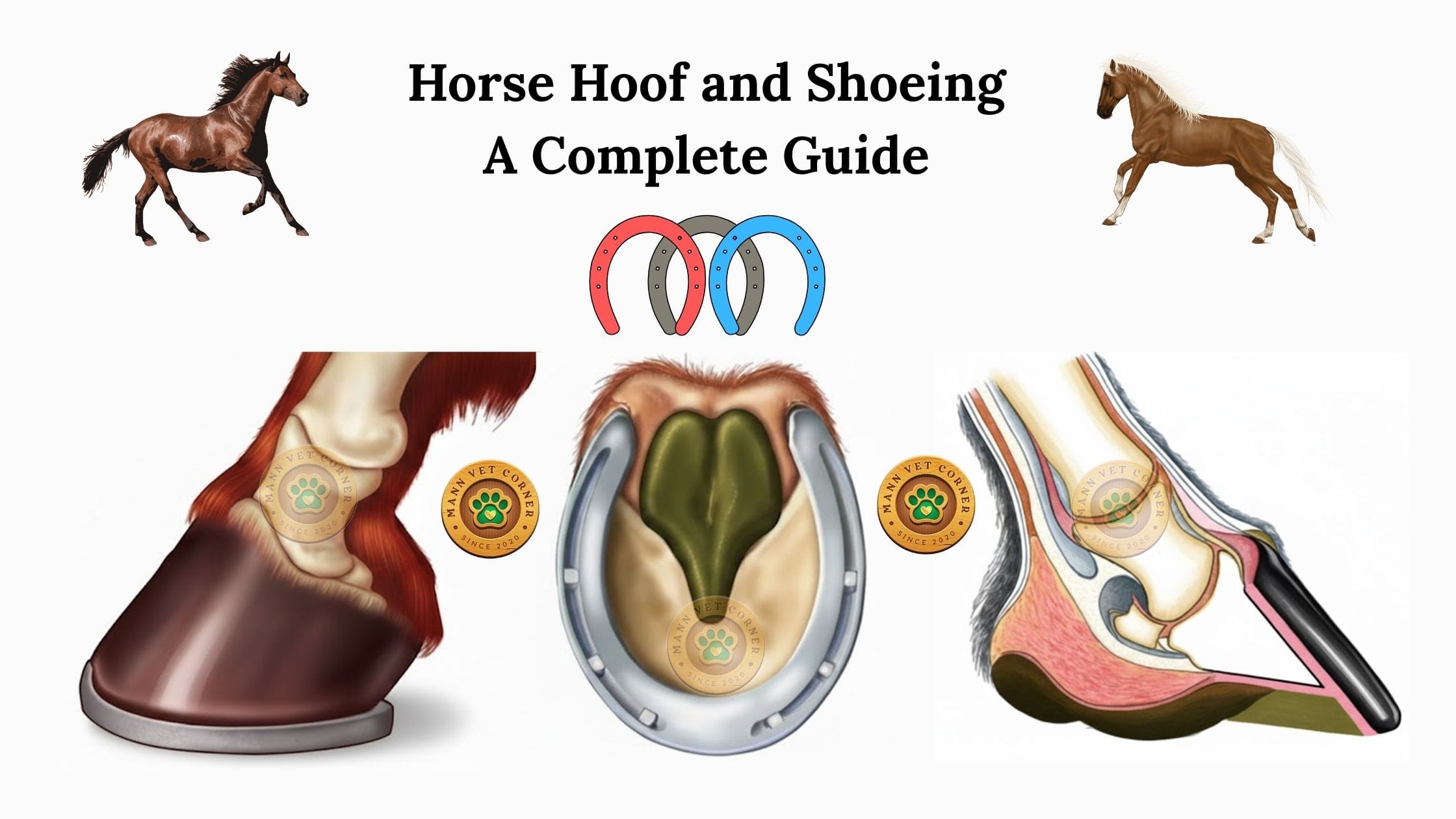
The horse hoof is a complex structure that supports the horse’s weight, absorbs shock, and provides traction, playing a crucial role in the animal’s mobility and overall health. The domestication of horses, placing them in wetter environments and reducing their activity, has made their hooves less hardened and more prone to injury. Horse owners and equestrian enthusiasts often wonder about the fascinating world of horseshoes and hoof care. Whether you’re curious about how horseshoes work, what happens during the shoeing process, or if horseshoes cause pain to horses, this comprehensive guide covers everything you need to know about equine hoof health and horseshoe applications.
Understanding Horse Hoof Anatomy: The Foundation of Equine Movement
Before we explore horseshoes, understanding the complex structure of a horse’s hoof helps explain why proper hoof care matters so much for your horse’s wellbeing.
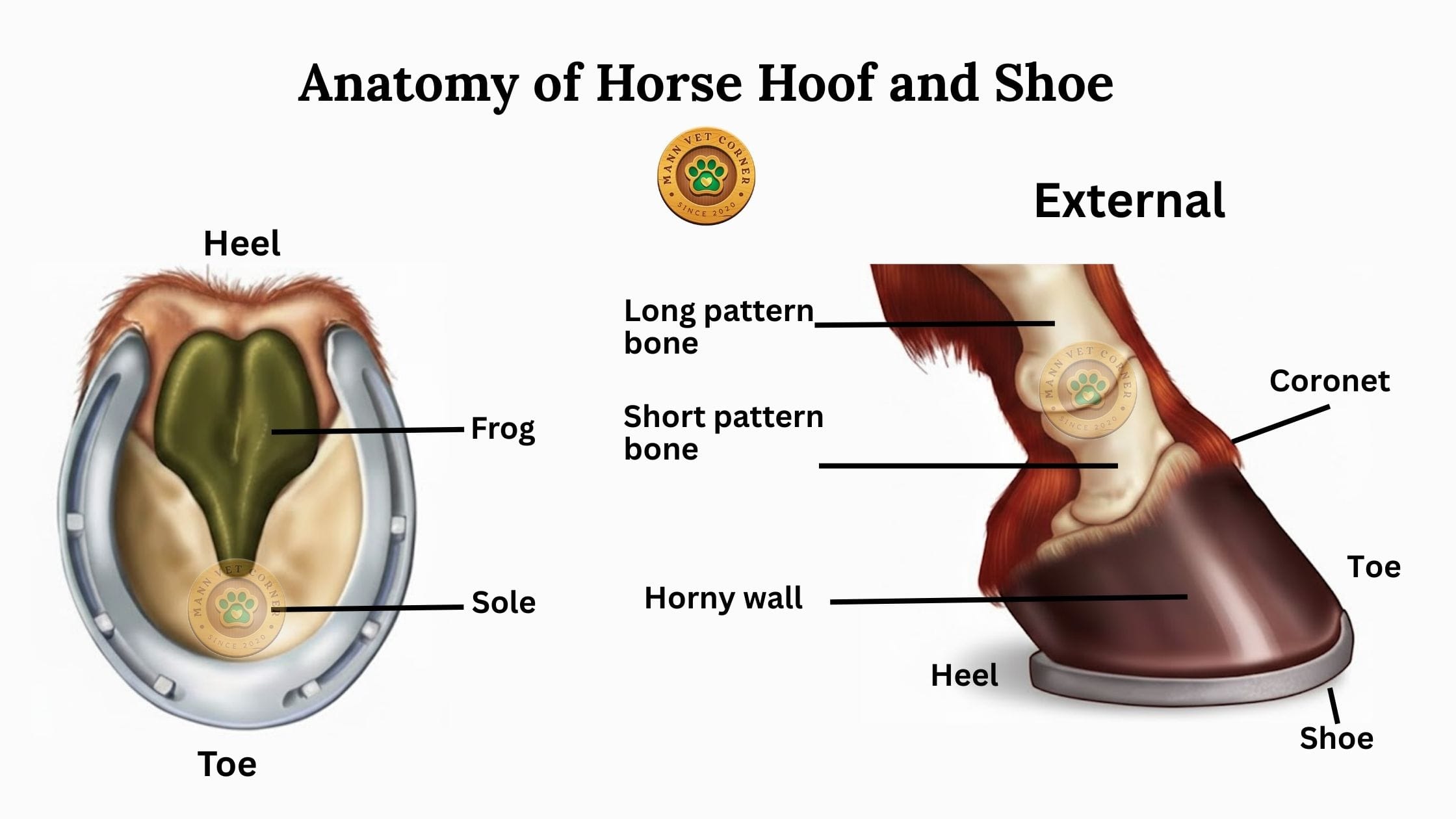
External Hoof Structures
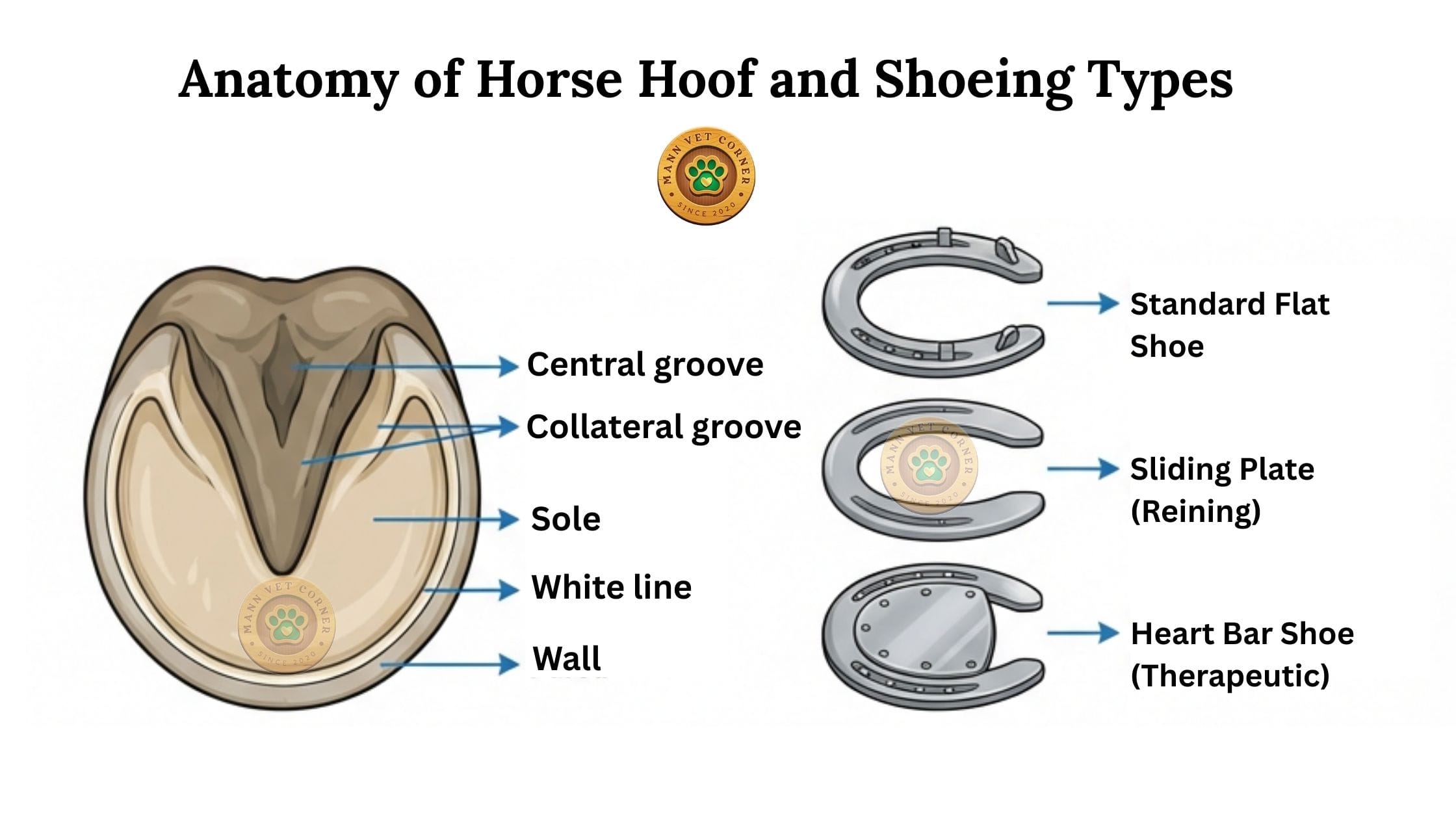
The horse’s hoof consists of several remarkable components working together to support the animal’s entire weight. The hoof wall forms the hard outer layer made primarily of keratin, the same protein found in human fingernails. This protective barrier bears the horse’s weight and shields internal structures from injury.
At the ground-facing surface, you’ll find the sole, which covers the bottom of the hoof and provides protection to sensitive internal tissues. The sole has a slightly curved shape that allows the hoof to expand when bearing weight and contract when lifted, creating a natural shock absorption system.
The frog represents one of the most important structures in hoof anatomy. This V-shaped, rubbery structure extends across approximately two-thirds of the sole. The frog serves multiple critical functions: it acts as a shock absorber, provides grip on various surfaces, and works like a pump to move blood back up the leg from this extremity. The grooves along the sides of the frog allow it to expand when contacting the ground.
The coronary band marks where skin meets the hoof wall. This area contains a rich blood supply that nourishes the hoof and generates new tissue, allowing the hoof wall to grow continuously throughout the horse’s life.
Internal Hoof Anatomy
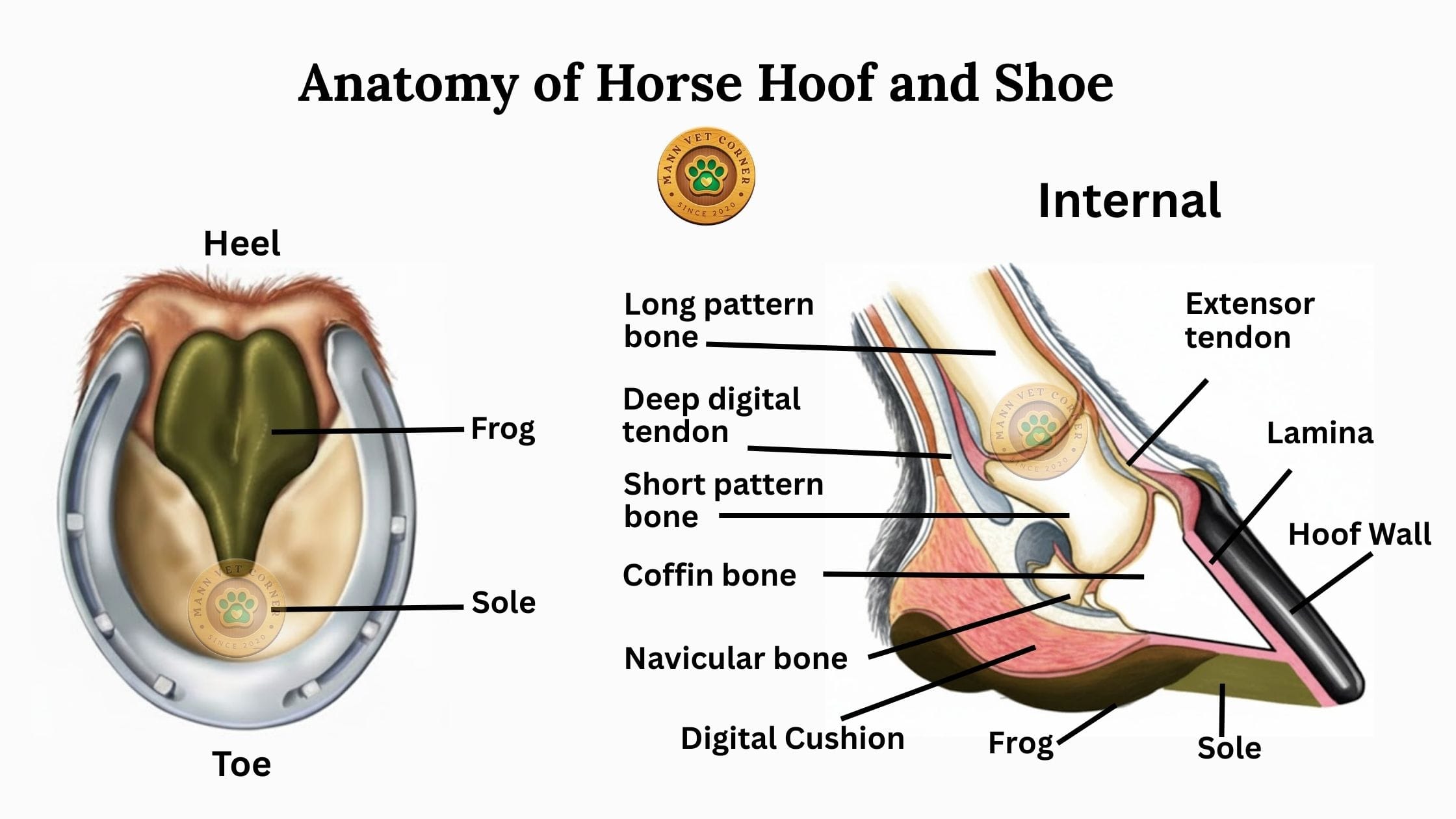
Inside the hoof capsule, sophisticated structures work together to support movement and weight distribution. The pedal bone (also called the coffin bone or P3) represents the main bone within the hoof. This arched structure spreads pressure throughout the entire bone, reducing tension and providing remarkable strength despite its relatively small size.
The navicular bone sits at the back of the pedal bone, acting as a pulley for the deep digital flexor tendon. This bone resides within the navicular bursa, a fluid-filled sac that allows smooth tendon movement.
The laminae create an intricate connection between the hoof wall and the pedal bone. These structures interlock like Velcro, forming a strong bond that suspends the pedal bone within the hoof capsule. The white line on the sole marks where these sensitive and non-sensitive laminae meet.
The digital cushion sits between the pedal bone and the deep digital flexor tendon, serving as the primary shock absorber. This mass of flexible tissue helps form the horse’s heels and pushes blood back up the leg with each step.
What Is Shoeing a Horse? The Professional Process Explained
Shoeing a horse involves fitting and securing protective metal plates to the hooves. This skilled craft combines knowledge of equine anatomy with metalworking expertise. A professional farrier performs this important work, which typically happens every four to six weeks.
The Horseshoeing Process Step by Step
The farrier begins by examining each hoof carefully, assessing overall condition and identifying any potential issues. If the horse already wears shoes, the farrier removes them using specialized pincers called shoe pullers.
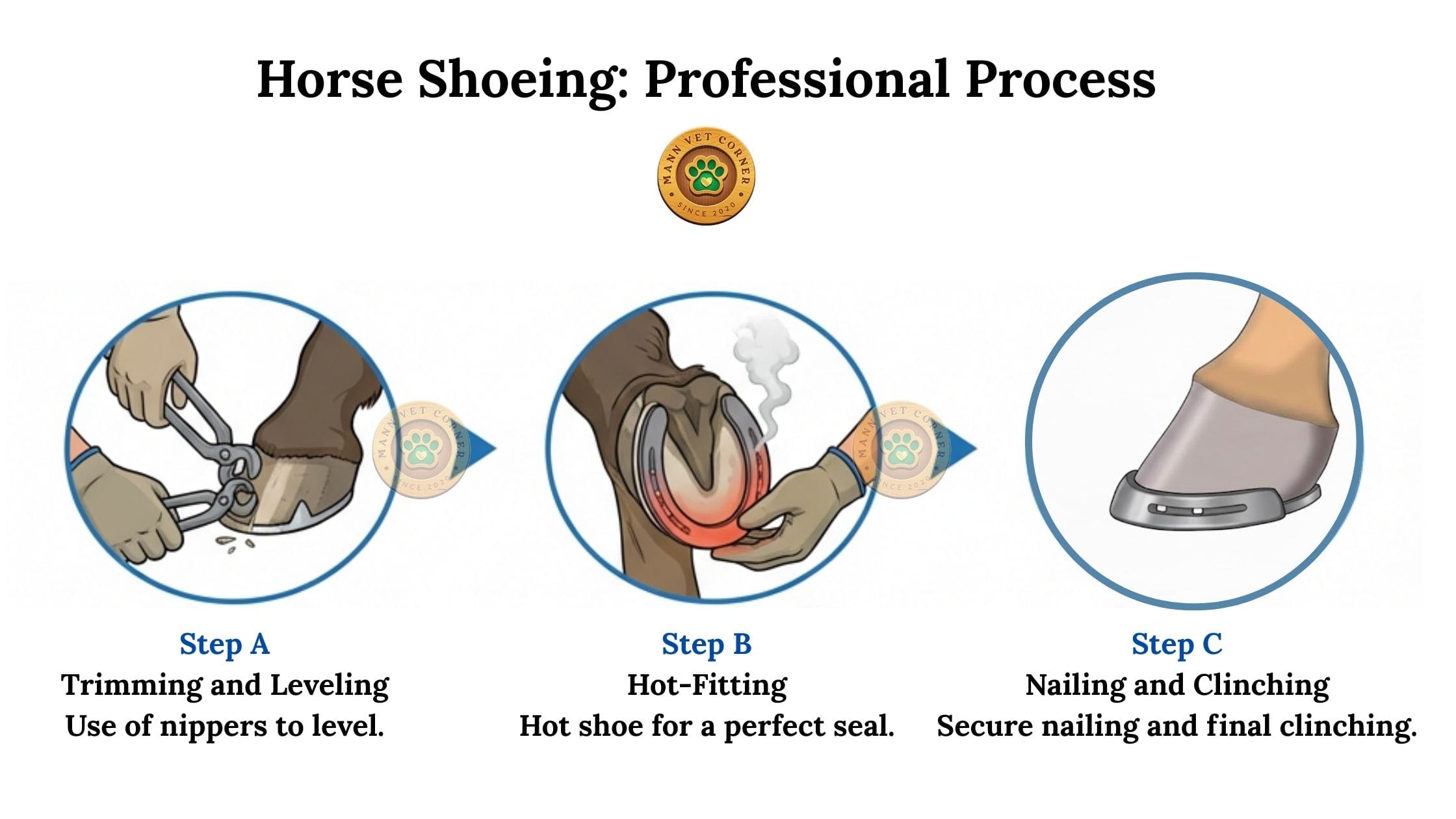
Next comes hoof trimming. The farrier uses sharp nippers to trim the hoof wall to the desired length and employs a hoof knife to carefully shape the sole and frog. This process resembles trimming fingernails on a much larger scale and removes excess growth that would otherwise cause imbalance.
The farrier then prepares the horseshoe, often heating it to shape the metal precisely to match each hoof’s unique contours. This “hot shoeing” process became common in the 16th century and remains popular because it allows for perfect customization.
Once shaped correctly, the farrier positions the horseshoe on the hoof and drives nails through the shoe into the hoof wall. These nails enter the wall at the outer edge of the white line and emerge about 15 to 20 millimeters from the base. The farrier places nails only in the toe and quarters, never in the heels, which need to remain flexible.
Finally, the farrier bends and trims the nails flush with the hoof wall, then uses a rasp to smooth any sharp edges. Many farriers watch the horse move with new shoes to confirm everything fits properly and the horse moves correctly.
Is a Horseshoe Painful for Horses? Understanding the Truth
One of the most common questions people ask is whether horseshoes hurt horses. The answer depends entirely on proper application and fit.
Why Properly Fitted Horseshoes Don’t Hurt
When a skilled farrier performs the shoeing correctly, the process causes no pain whatsoever. The outer hoof wall contains no nerve endings, making it insensitive to the nails driven through it. This area is anatomically similar to human fingernails or toenails.
Farriers trim and nail into the insensitive part of the hoof exclusively. The horse feels no more discomfort than you would feel trimming your nails with clippers.
When Horseshoes Can Cause Pain
However, mistakes or improper care can lead to discomfort:
Hot Nails occur when a farrier accidentally drives a nail into the sensitive laminae beneath the hoof wall. This causes immediate, severe pain comparable to driving a nail through your fingernail into the skin beneath. Experienced farriers rarely make this mistake, but the horse will react instantly if it happens.
Poor Fit creates problems when shoes are too tight, too loose, or incorrectly shaped. Shoes that don’t match the hoof’s unique contours can cause pressure points, leading to bruising, cracking, or other painful conditions.
Neglected Maintenance causes issues when horses go too long between farrier visits. Overgrown hooves with shoes still attached can create imbalance and strain on joints and soft tissues.
Pre-existing Bruising makes the shoeing process uncomfortable if the horse has been ridden extensively on hard surfaces without shoes, developing bruises under the hooves before shoeing.
Types of Horseshoes: Finding the Right Fit for Your Horse
Horseshoes come in various materials and designs, each serving specific purposes based on the horse’s needs, activities, and any medical conditions.
Regular Horseshoes
The classic U-shaped horseshoe made from steel or aluminum represents the most common type. These provide excellent protection for horses’ hooves whether working around the stable or traversing open terrain. The traditional design includes holes around the perimeter where nails sit securely without damaging the hoof.
Material Variations
Steel Shoes offer durability and versatility, making them ideal for everyday riding and working horses. They’re preferred in sports requiring strong, long-wearing shoes such as polo, eventing, show jumping, and western riding events.
Aluminum Shoes weigh significantly less than steel, making them popular for racehorses where reducing overall weight carried by the horse improves performance. These lightweight shoes often facilitate certain types of movement and are favored in dressage.
Rubber and Plastic Shoes use modern materials offering flexibility and superior shock absorption. These work well for horses with sensitive hooves or those recovering from injuries.
Specialized Horseshoe Types
Bar Shoes feature an added bar at the back connecting the two ends of the shoe. This bar, either curved or straight, provides extra support to the hoof, lower leg, and heel. Bar shoes help horses with specific conditions like navicular disease or laminitis. However, because horses’ hooves naturally expand and contract with movement, bar shoes limit this motion and may come off more easily if the horse steps on the bar area.
Rim Shoes look similar to regular horseshoes but include a large groove in the center called “fullering” that provides enhanced traction. This design helps horses maintain grip on various surfaces.
Egg Bar Shoes extend beyond the heel in an oval shape, offering additional heel support for horses with underrun heels or navicular disease. When used with heel wedges, they transfer force from the navicular area to the forward anatomy of the hoof, increasing weight-bearing surface and supporting the fetlock.
Therapeutic Shoes are custom-made to address specific hoof problems and promote healing. These specialized shoes help manage various conditions and correct biomechanical issues.
Corrective Shoes deviate from the normal U-shape to change how the hoof is positioned or responds to ground forces. Farriers use these to address conformational issues, support proper movement, and manage chronic conditions.
What Is the Meaning of Hoof Shoes? Historical and Cultural Significance
The term “hoof shoes” simply refers to horseshoes – protective coverings for horses’ hooves. Beyond their practical purpose, horseshoes carry rich cultural significance.
Historical Development
The practice of protecting horses’ hooves dates back to ancient times. Early civilizations wrapped horses’ hooves in rawhide or leather for protection. The Romans attempted solid-bottomed “hipposandals” with some resemblance to modern hoof boots.
The earliest clear written record of iron horseshoes appears around 910 AD, referring to “crescent figured irons and their nails.” By 1000 AD, cast bronze horseshoes with nail holes became common in Europe. The 13th and 14th centuries brought widespread manufacturing of iron horseshoes.
In 1835, the first United States patent for a horseshoe manufacturing machine capable of producing up to 60 horseshoes per hour was issued. This industrialization reflected horseshoes’ importance to society.
Cultural Symbol
Horseshoes have long been considered lucky charms. They were originally made from iron, a material believed to ward off evil spirits. Traditional horseshoes used seven nails, and seven is often called the luckiest number.
Throughout Europe, worn horseshoes were placed above or beside doorways to guard homes, barns, and stables. This custom remains visible across Italy, Germany, Britain, and Scandinavia. Horseshoe-shaped decorations appear in various forms worldwide.
Can a Horse Live Without a Hoof? Understanding Hoof Loss
The question “can a horse live without a hoof” addresses one of the most serious concerns in equine health. The traditional saying “no hoof, no horse” reflects how critical hooves are to a horse’s survival and quality of life.
The Reality of Hoof Loss
Complete hoof loss represents a devastating injury for horses. Without a hoof, horses experience severe lameness, difficulty walking, and increased vulnerability to further injuries. The hoof serves as the foundation for the entire leg and body, bearing tremendous weight and absorbing shock with each step.
Historically, losing a hoof often meant euthanasia for horses. However, modern veterinary science has made remarkable advances.
Modern Solutions
Advancements in veterinary technology now provide alternatives through prosthetic hooves. These custom-made devices fit the horse’s remaining limb structure and provide support for mobility.
Prosthetic hooves are typically manufactured from lightweight, durable materials such as carbon fiber or titanium. They’re designed to mimic natural hoof movements and provide support and shock absorption. The attachment methods vary, including straps, velcro, or surgical implants, depending on the specific design and individual requirements.
While prosthetic hooves significantly improve a horse’s mobility and quality of life, they’re not perfect substitutes for natural hooves. They require ongoing maintenance, regular adjustments, and careful monitoring. The cost can be substantial, but for many horse owners, the ability to give their horse a comfortable life justifies the investment.
Severe Hoof Damage
Even without complete hoof loss, severe hoof damage can compromise a horse’s ability to function normally. Chronic conditions like navicular disease, severe laminitis, or extensive hoof wall damage can cause long-term pain and loss of function.
Responsible horse owners must prioritize regular hoof care to prevent these devastating conditions from developing.
Wild Horses vs. Domesticated Horses: Why Shoeing Became Necessary
Understanding why wild horses thrive without shoes while domesticated horses often need them reveals important insights about hoof health and care.
How Wild Horses Maintain Their Hooves
Wild horses travel 10 to 20 miles daily across diverse, often abrasive terrain. This constant movement naturally wears down their hooves, keeping them trim and healthy. The varied surfaces they encounter – from rocky ground to hard-packed dirt – provide natural filing that prevents overgrowth.
Additionally, natural selection means wild horses with genetically healthier, stronger hooves survive to reproduce. Over generations, this creates populations with naturally robust feet adapted to their environment.
Why Domesticated Horses Need Different Care
Domesticated horses live very different lives. They’re often confined to stalls or small paddocks with soft, damp ground that doesn’t wear down hooves naturally. They don’t travel the distances wild horses do, so their hooves grow continuously without natural wear.
Furthermore, humans have selectively bred domestic horses for traits like speed, strength, and temperament rather than hoof quality. This means many domestic horses don’t have the genetically superior hooves that wild horses possess.
When horses carry riders, pull heavy loads, or work on hard surfaces like pavement or roads, their hooves wear down faster than they would naturally. Horseshoes protect against this excessive wear while supporting the additional weight and stress.
The Barefoot Movement
Not all domesticated horses require shoes. The barefoot movement in horse care argues that with proper management, many horses can maintain healthy hooves without shoes. Horses living on appropriate surfaces, getting adequate exercise, and receiving proper nutrition may thrive barefoot.
Scientific research suggests barefoot horses may develop stronger hooves, improved circulation, and better overall musculoskeletal health. However, this approach requires commitment to proper environment, exercise, and nutrition.
The decision whether to shoe depends on individual factors: the horse’s genetics, hoof quality, workload, riding discipline, living conditions, and owner preferences.
Horseshoe Anatomy: Understanding the Parts of a Shoe
While we’ve discussed hoof anatomy extensively, understanding horseshoe anatomy itself helps horse owners appreciate the farrier’s craft.
A typical horseshoe includes several key features:
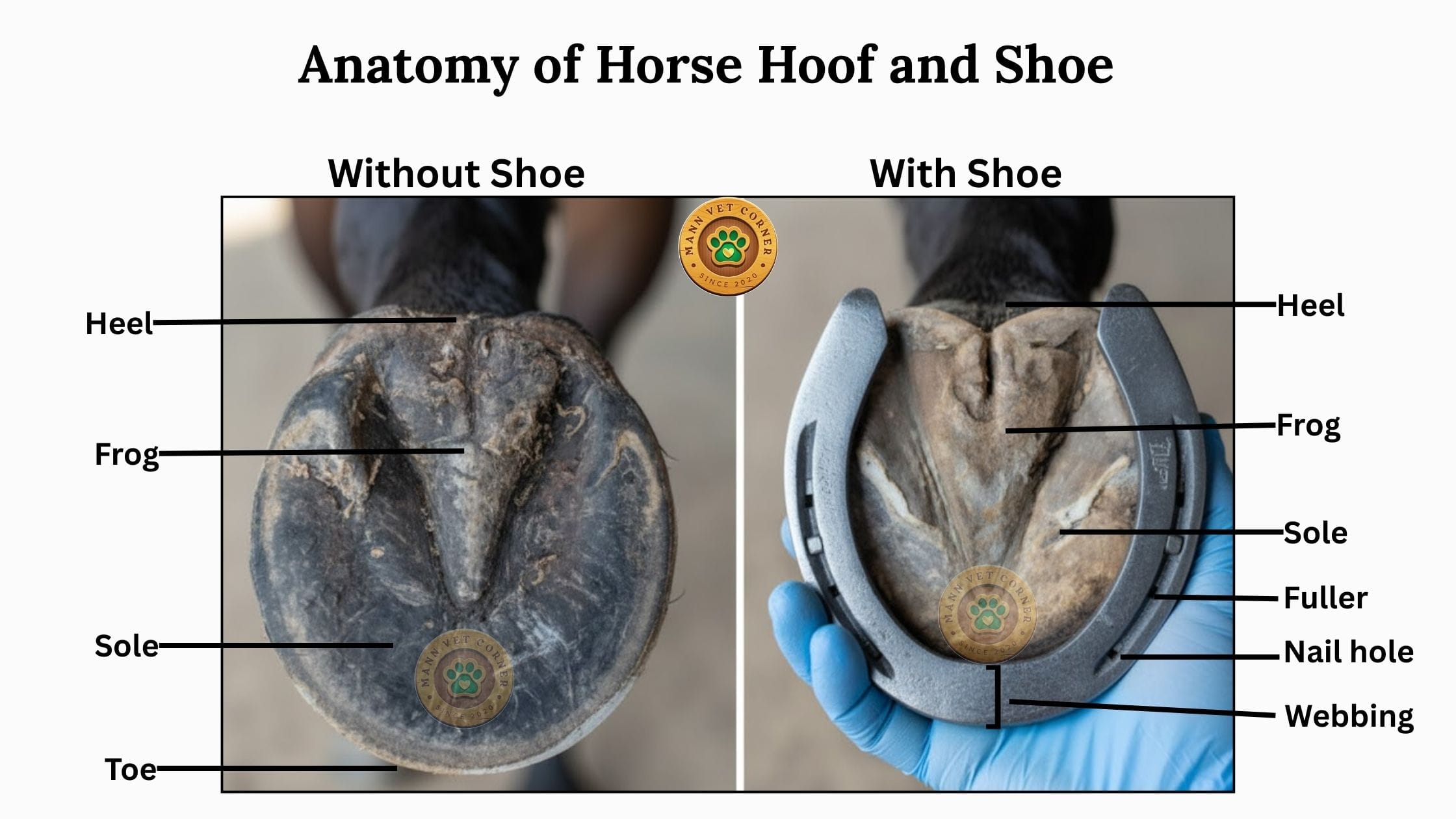
The branches are the two sides of the U-shape extending from toe to heel. These bear the horse’s weight and must be properly shaped to match each hoof’s unique contours.
The nail holes (typically six to eight) allow the farrier to secure the shoe to the hoof wall. The number and placement of holes vary based on shoe size and type.
The heels are the ends of the branches at the back of the shoe. Some shoes have extended heels for additional support, while others keep heels short.
The toe is the front curve of the shoe that follows the natural curve of the hoof wall.
Some shoes include clips – small raised sections that help position the shoe correctly and prevent it from shifting. Toe clips sit at the front, while quarter clips appear on the sides.
Fullering refers to the groove running around the ground surface of some shoes, providing space for nail heads and improving traction.
Essential Hoof Care: Maintaining Healthy Hooves
Whether your horse wears shoes or goes barefoot, consistent hoof care remains crucial for their health and soundness.
Regular Farrier Visits
Schedule farrier visits every 4 to 8 weeks, depending on your horse’s individual needs. Regular trimming prevents imbalance that can lead to joint strain, tendon stress, and chronic conditions like navicular disease.
Daily Hoof Cleaning
Pick out your horse’s hooves daily to remove dirt, rocks, and debris. This simple practice prevents thrush, bruising, and puncture wounds while allowing you to spot problems early.
Proper Nutrition
Feed a balanced diet that supports hoof growth and strength. Key nutrients include biotin (20 mg daily improves hoof wall strength), zinc (supports keratin formation), and amino acids like methionine and lysine (building blocks for hoof tissue).
Environmental Management
Provide dry areas for horses to stand. Constant exposure to wet, muddy conditions softens hooves and promotes bacterial and fungal infections like thrush. Balance this with occasional moisture to prevent hooves from becoming brittle.
Exercise and Movement
Regular exercise stimulates circulation in the hooves, promoting healthy growth and development. Movement flexes hoof structures and strengthens the digital cushion and other internal components.
Common Hoof Problems and Their Solutions
Understanding common hoof issues helps horse owners recognize problems early and seek appropriate care.
Thrush
This bacterial infection affects the frog, creating a foul-smelling black discharge. It develops in wet, dirty conditions. Treatment involves cleaning the hoof thoroughly, applying antimicrobial treatments, and improving environmental conditions.
Laminitis
This painful condition involves inflammation of the laminae connecting the hoof wall to the pedal bone. Severe cases can cause the pedal bone to rotate or sink within the hoof capsule. Laminitis requires immediate veterinary attention and may need specialized therapeutic shoeing.
Navicular Disease
This degenerative condition affects the navicular bone and surrounding structures, causing heel pain and lameness. Egg bar shoes with wedges often help manage symptoms by redistributing pressure away from the navicular area.
Hoof Cracks
Cracks in the hoof wall can range from superficial to severe. They may result from improper trimming, nutritional deficiencies, or environmental factors. Treatment depends on severity and may include corrective trimming, special shoes, or hoof wall repair.
White Line Disease
Also called seedy toe, this condition involves separation of the hoof wall from the underlying structures, often due to bacterial or fungal infection. It requires removal of affected tissue and careful monitoring during regrowth.
Making the Right Choice for Your Horse
Deciding whether your horse needs shoes involves considering multiple factors:
Work Level: Horses in regular work, especially on hard or varied surfaces, typically benefit from shoes. Light work or pasture life may not require them.
Hoof Quality: Strong, healthy hooves adapt better to barefoot life. Thin soles, weak hoof walls, or conformational issues may necessitate shoes.
Medical Conditions: Horses with navicular disease, laminitis, or other conditions often need specialized shoeing for comfort and function.
Environment: Horses on rocky terrain or hard surfaces benefit more from shoes than those on soft pasture.
Discipline: High-impact activities like jumping, racing, or extended trail riding often require the protection shoes provide.
Consult with your veterinarian and a qualified farrier to make the best decision for your individual horse. Some horses thrive with a hybrid approach – barefoot during lighter work periods and shod when activities intensify.
Conclusion: The Art and Science of Hoof Care
Horseshoes and hoof care represent a fascinating intersection of tradition, craftsmanship, and modern veterinary science. From the complex anatomy of the horse’s hoof to the skilled work of farriers, every aspect contributes to keeping horses healthy, sound, and comfortable.
Whether you choose traditional shoeing, modern alternatives, or barefoot management, the key lies in understanding your horse’s individual needs and providing consistent, quality care. Regular farrier visits, daily hoof maintenance, proper nutrition, and appropriate environmental management all work together to support optimal hoof health.
Remember that properly fitted horseshoes don’t hurt horses – they protect and support them, allowing them to work comfortably and move confidently across various terrains. The ancient saying “no hoof, no horse” remains true today: healthy hooves form the foundation of a healthy, happy horse.
By understanding hoof anatomy, the shoeing process, and the various options available, you can make informed decisions that support your horse’s wellbeing for years to come. Whether your horse sports the latest in therapeutic shoeing or enjoys life with bare hooves, what matters most is the quality of care, attention, and expertise you provide.
