

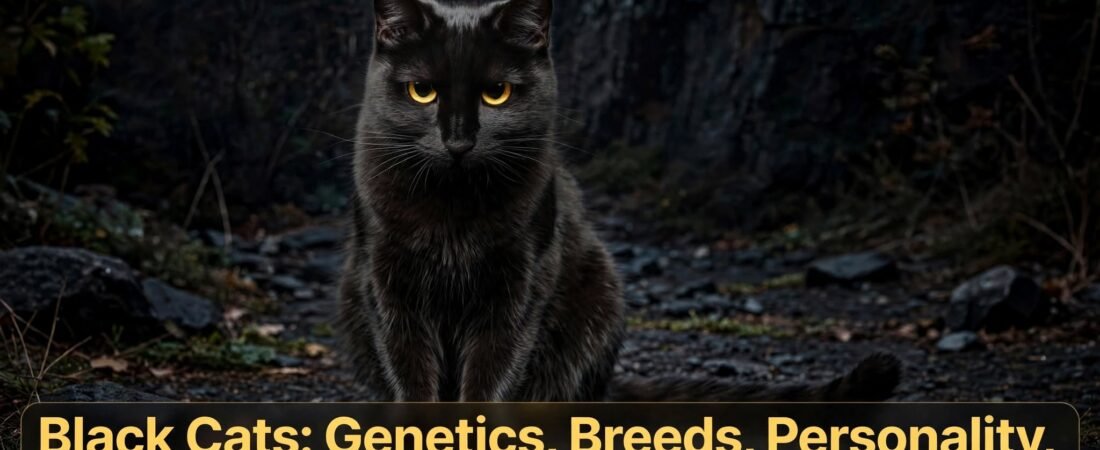
Quick Answer: What Is a Black Cat?
A black cat is a domestic cat whose fur is solid black because of a high concentration of the pigment eumelanin. Black is a coat color, not a breed: it appears in more than 20 recognized cat breeds and in many mixed-breed cats, and the Bombay is the only breed that is always solid black. Black cats are just as affectionate, loyal and playful as cats of any other color. However, their coats can fade to a brownish or reddish "rust" shade after prolonged exposure to sunlight. Let's more detail in Black Cats: Genetics, Breeds, Personality, Superstitions & Care.
Black cats are among the most striking, most misunderstood, and most searched-for pets in the world. They are beautiful and affectionate companions, and their coat genetics are some of the most interesting in the animal kingdom. Meanwhile, for centuries, people have wrapped them in myths and superstitions that have little to do with how real black cats behave. So whether you are thinking about adopting one, wondering why your black cat is turning brown, or simply curious about the science behind that glossy dark coat, this guide covers it all. In addition, every section reflects veterinary-informed accuracy.
In This Guide
- What Is a Black Cat?
- Why Are Cats Black? The Genetics of Black Fur
- Black Cat Breeds: Which Cat Breeds Come in Black?
- Black Cat Personality and Temperament: Myth vs. Evidence
- Black Cat Health and Lifespan
- Why Do Black Cats Turn Brown or Reddish? (Rusting Coats)
- Black Cat Superstitions and History
- Black Cat Adoption and Halloween Safety
- Black Cat Care Guide: Grooming, Diet, Safety and Photography
- Black Cat Names and Special Days
- Frequently Asked Questions About Black Cats
- Conclusion: Why Black Cats Deserve the Spotlight
What Is a Black Cat?
A black cat is a domestic cat (Felis catus) with black fur that results from a high concentration of melanin pigment. The term describes appearance only. For example, a black cat can be a purebred Bombay, a fluffy Maine Coon, a hairless-looking Sphynx with dark skin, or an ordinary domestic shorthair from a shelter. In fact, most black cats in the world are domestic shorthairs and longhairs of mixed ancestry.
What Does a Black Cat Look Like?
A true solid black cat has jet-black fur from root to tip, black whiskers, and often dark nose leather and paw pads. Eye color also plays a major role in the look. The most common eye colors in black cats include:
- Gold or yellow: the classic black cat look, and also very common in domestic cats
- Copper or deep orange: the signature of the Bombay breed
- Green: common in some domestic cats, short-haired cats, and Persian cats
- Blue or odd-eyed: rare, and possible only when white genes are also present, so these cats are usually not solid black
Black Smoke and "Undercover Tabby" Cats
However, not every black-looking cat is a true solid. A black smoke cat, for instance, has a white or pale undercoat that shows when the fur moves. In addition, many black cats are what enthusiasts call "undercover tabbies": they carry a tabby pattern genetically, but heavy black pigment masks it. In bright sunlight, you can sometimes see faint stripes or swirls, which people call ghost markings. These appear most often on kittens and on cats with a thinner coat.
Why Are Cats Black? The Genetics of Black Fur
Melanocytes in the hair follicle make eumelanin, the dark brown-black pigment that colors black fur. However, the shade and pattern of a cat's coat depend on more than pigment alone. They also depend on how much eumelanin the cat makes, where it deposits the pigment, and whether other genes dilute, mask or modify it.
The Key Genes Behind a Solid Black Coat
| Gene / locus | What it controls | Role in black cats |
|---|---|---|
| ASIP (Agouti) | Switches the banded "agouti" tabby pattern on or off along each hair | Two copies of the recessive non-agouti (a) allele turn the tabby banding off, giving a solid color. In domestic cats, this allele is a small DNA deletion in the ASIP gene |
| TYRP1 (B locus) | Determines the shade of eumelanin: black, chocolate or cinnamon | The B allele produces black and dominates the chocolate (b) and cinnamon (bᴸ) alleles |
| MLPH (D locus) | Controls the density of pigment granules | Dense (D) gives true black, while two copies of the recessive dilute (d) allele turn black into blue (gray) |
| KIT (W locus) | Controls white spotting and dominant white | Dominant white masks all color, and black-and-white "tuxedo" cats have white spotting plus black |
| O locus (X-linked) | Switches between eumelanin and the red pigment pheomelanin | The orange (O) allele sits on the X chromosome and overrides black, so orange and tortoiseshell cats look different from black cats |
Is Black the "Dominant" Coat Color? A Common Misconception
Many pet websites call black the most genetically dominant feline coat color. However, the reality is more nuanced. The black pigment allele (B) is dominant over chocolate and cinnamon, but the solid effect depends on the recessive non-agouti (a) allele, so a cat must inherit it from both parents. For this reason, two tabby parents can produce a black kitten. Likewise, black can be very common in some populations without being "dominant" in the strict Mendelian sense.
Why Black Is So Common in Domestic Cats
You can find black cats in every part of the world and across many random-bred cat populations. Popular theories also include genetic drift, human preference in certain regions and a possible survival advantage in some environments. Still, genetics alone do not explain it. Nevertheless, they show that melanism is a stable, widespread and evolutionarily successful trait.
Melanism Across the Cat Family
Melanism, the genetic tendency toward very dark pigmentation, has evolved independently in a number of wild cat species. For example, genetic studies, including a widely cited 2003 paper in Current Biology, found that different mutations produce melanism in domestic cats and in wild felids such as jaguars and leopards. Because melanism evolved repeatedly, researchers have speculated that it may offer advantages such as camouflage in dense forest or differences in disease resistance. However, these ideas remain active research areas, and no study has proven that black domestic cats are healthier than other cats.
Is a Black Panther a Black Cat?
Not exactly. A black panther is not a distinct species. Instead, the name refers to a melanistic leopard (Panthera pardus) in Asia and Africa or a melanistic jaguar (Panthera onca) in the Americas. When the light is right, you can see a black panther's rosettes, just like the ghost stripes of a black domestic cat. Although the two animals share the pigment-based trait of melanism, they are very different species with different mutations.
Black Cat Breeds: Which Cat Breeds Come in Black?
Black is not a single breed. Instead, registries recognize solid black fur in around 22 cat breeds (the exact number varies by registry), including the Maine Coon, Persian and Sphynx. If you want a black cat with a predictable look, size and temperament, a pedigreed breed is one option. However, if you simply want a black cat, a shelter domestic shorthair is just as lovely.
Black Cat Breeds at a Glance
| Breed | Size / coat | Typical temperament | Notes |
|---|---|---|---|
| Bombay | Medium, muscular; short, satin-like coat | Affectionate, people-oriented, playful | The only breed that is exclusively solid black, including nose, paw pads and whiskers. It has copper or gold eyes |
| Maine Coon | Large; long, shaggy coat | Gentle, social, "dog-like" | Black is one of many colors, and the coat needs regular brushing |
| Persian | Medium; very long, dense coat | Calm, quiet, sweet-natured | Needs daily grooming, and the flat face can cause eye and breathing issues |
| Sphynx | Medium; hairless or fine down | Outgoing, energetic, attention-seeking | Has dark skin pigmentation and needs skin care and warmth |
| British Shorthair | Medium to large; plush, dense coat | Easygoing, independent but loyal | Black British Shorthairs are popular and strikingly glossy |
| American Shorthair | Medium; short, thick coat | Adaptable, friendly, good family cat | Parent breed of the Bombay |
| Orient Shorthair | Slender; very short coat | Vocal, intelligent, very social | Registries recognize ebony as a solid color |
| Norwegian Forest Cat | Large; long, water-resistant double coat | Gentle, independent, climbs | Black appears with or without white |
| Manx | Medium; short or long coat, tailless or short-tailed | Playful, loyal, dog-like | Black is common among Manx cats |
| Cornish and Devon Rex | Small to medium; curly, soft coat | Mischievous, energetic | Black rex cats have a velvety, wavy look |
| Scottish Fold | Medium; folded ears | Sweet, quiet, adaptable | Responsible breeding matters because of cartilage-related health concerns |
| Turkish Angora | Medium; silky, long coat | Elegant, active, intelligent | Some registries accept black |
Breed color standards vary by registry (CFA, TICA, FIFe and others), so always check the standard of your chosen registry.
The Bombay: The "Mini Panther" of the Cat World
American breeder Nikki Horner of Louisville, Kentucky developed the Bombay in the 1950s. Her goal was a pet cat that looked like a miniature black panther, so she crossed sable Burmese cats with black American Shorthairs. As a result, the cats had the Burmese's muscular build and affectionate nature along with a gleaming black coat. The breed then gained championship recognition from the Cat Fanciers' Association in the mid-1970s. Today, it is the only breed whose standard allows only solid black, down to the nose leather and paw pads.
Owners often describe Bombays as "velcro cats" that follow their people from room to room, enjoy lap time and tolerate being carried. Therefore, they do best in homes where someone is around for much of the day.
Black Cat Personality and Temperament: Myth vs. Evidence
The most important fact about black cat personality is also the simplest: black cats are just as loving, loyal and independent as cats of other colors. In fact, they can be affectionate family members, social and playful, depending on their breed, genetics, early socialization and upbringing.
What Does the Research Say About Coat Color and Behavior?
Several studies have also asked whether coat color predicts feline personality. However, most of them rely on owner reports and public perceptions rather than controlled behavioral testing, so they cannot support firm conclusions. For example, some surveys found that people describe tortoiseshell and bicolor cats as more "spirited" and black cats as calm and friendly. Still, no scientific evidence shows that black pigment causes a particular temperament. Instead, breed, parentage, early handling between 2 and 7 weeks of age and individual experience matter far more.
Common Black Cat Personality Traits
- Affectionate: many black cats seek out laps, cuddles and shared sleeping spots
- Social and playful: they also enjoy interactive toys, puzzle feeders and climbing
- Loyal: they also often bond closely with one or two people
- Independent: like all cats, they also value quiet time and a safe space
- Adaptable: many black cats settle well in homes with children, other cats and cat-friendly dogs when you introduce them properly
However, your black cat's personality will be unique. Therefore, meet the individual cat before you adopt, and ask the shelter or breeder about its history and handling.
Black Cat Health and Lifespan
Do Black Cats Live Longer?
Some people claim that black cats live longer, because some research has suggested that melanism could link to certain biological advantages. However, the evidence is preliminary, and there is no reliable data showing that coat color alone changes the lifespan of a pet cat. Instead, a well-cared-for indoor cat of any color typically lives 12 to 18 years, and some reach their early 20s.
Factors That Affect Your Cat's Lifespan
- Indoor vs. outdoor lifestyle: indoor cats usually live longer because they face fewer risks from traffic, predators, infectious disease and parasites
- Preventive veterinary care: annual exams (twice yearly), vaccinations, dental care and weight control all help
- Nutrition: a complete and balanced diet suited to life stage keeps body weight healthy
- Breed-related conditions: for example, hypertrophic cardiomyopathy in Maine Coons and Bombays, and polycystic kidney disease in Persians
- Parasite control: fleas, ticks, intestinal worms and, where relevant, heartworm all need prevention
- Spay or neuter status and enrichment also reduce stress
Also, if you bring home a pedigreed black cat, ask the breeder for health test results relevant to the breed, such as cardiac screening and DNA tests.
Why Do Black Cats Turn Brown or Reddish? (Rusting Coats)
Many owners notice that their jet-black cat starts to look brownish or rusty, especially in summer. Owners call this rusting, and it is usually harmless. For example, sunlight (UV rays) can break down the melanin in a cat's fur, so black coats turn a brownish or reddish shade.
Common Causes of a Rusty Black Coat
| Cause | How it affects the coat | What you can do |
|---|---|---|
| Sun exposure (UV light) | UV breaks down eumelanin in the hair shaft, bleaching black to brown or rust. This effect shows most on the back and top of the head | Reduce hours of direct sun in a favorite window with sheer curtains or UV-filtering window film. Also, new black fur grows in after shedding |
| Diet and amino acids | Cells build melanin from the amino acid tyrosine. Therefore, a very low-quality or unbalanced diet may contribute to dull or rusty fur | Feed a complete and balanced commercial diet. Do not supplement amino acids without veterinary advice |
| Shedding and coat cycles | Old fur at the end of its growth cycle can look dull and brownish before it sheds | Brush regularly, because it removes old hair and brings out shine |
| Age and genetics | Some cats have naturally lighter or more variable black. Also, kittens may have a brownish "kitten coat" that darkens | Normal, so you need no action |
| Illness or stress | Chronic disease, poor nutrition and some skin conditions can cause dull, patchy or discolored fur | If the change is sudden or patchy, or comes with other signs, see your veterinarian |
When to See a Veterinarian
Rusting from sunlight is usually gradual and even. However, book a vet visit if your cat's coat color changes suddenly, looks patchy, or comes with hair loss, itchiness, scaling, weight loss, changes in appetite or thirst, or lethargy.
Black Cat Superstitions and History
Few animals carry as much symbolism as the black cat. For thousands of years, people have worshipped, feared, blamed and celebrated black cats, often in the same region within a single century.
Black Cat Beliefs by Culture
| Culture / period | Belief about black cats |
|---|---|
| Ancient Egypt | Egyptians revered cats in general and associated them with the goddess Bastet, protector of the home. Harming a cat could carry severe penalties. Egyptians also valued cats for controlling rodents and snakes |
| Medieval Europe | People began linking black cats with witchcraft and the devil. For example, a papal document of 1233 (the bull Vox in Rama) describes a black cat in an alleged heretical ritual, which helped cement the association |
| United Kingdom and Ireland | Many people consider a black cat crossing your path or arriving at your door good luck. Sailors also kept black ship's cats for protection at sea |
| Japan | Many people see black cats as bringing good fortune and sometimes link them with warding off evil |
| United States | The belief that a black cat crossing your path means bad luck remains a popular folk superstition, especially around Halloween |
| Modern pop culture | From witches' familiars to Salem in Sabrina and Bagheera in The Jungle Book, black cats appear as both mysterious and lovable |
Superstition vs. Science
The key takeaway is that superstitions about black cats vary by culture and have no basis in science. In other words, a black cat is no more likely to bring bad luck than a cat of any other color.
Black Cat Adoption and Halloween Safety
Do Black Cats Take Longer to Get Adopted?
Animal shelters have long reported that people can overlook black cats. For example, lingering superstition, dark fur that photographs poorly in online listings and the sheer number of black cats entering shelters may all play a part. However, the research is mixed: some studies and shelters report longer stays for black cats, while others find little or no difference once they account for age, health and other factors. Either way, a black cat in a shelter is a wonderful companion waiting for a home.
Tips for Adopting a Black Cat
- Visit your local shelter or rescue and spend time with several cats, because personality matters more than color
- Ask about the cat's history, medical records, vaccinations and spay/neuter status
- Prepare a quiet room with litter, food, water, scratching posts and hiding places for the first week
- Then schedule a veterinary check within the first week or two
- Also consider adopting a pair of cats if you are away from home for long hours
Halloween Safety for Black Cats
Because of concern that people may adopt cats for the wrong reasons, some shelters pause black cat adoptions in the weeks around Halloween. However, policies vary and people debate them, and many shelters rely on careful screening instead. To keep your own black cat safe in October:
- Keep your cat indoors around Halloween, especially on trick-or-treat night
- Use a secure room if the doorbell will ring often, so your cat cannot escape
- Microchip your cat and keep the contact details up to date
- Keep chocolate, candy (especially anything with xylitol), candles, glow sticks and decorations out of reach
- Also, avoid costumes unless your cat clearly feels comfortable wearing one
Black Cat Care Guide: Grooming, Diet, Safety and Photography
Grooming a Black Cat
Black cats do not need special grooming. However, because dark fur shows dander, lint and dust, owners often notice grooming issues quickly.
- Short-haired black cats: brush once or twice a week with a rubber brush or soft bristle brush to remove loose hair and bring out shine
- Long-haired black cats: brush daily with a wide-tooth comb or slicker brush, so mats do not form
- Bathing: rarely needed, so use a cat-specific shampoo only if your vet recommends it
- Dander and flakes: more visible on black fur. Occasional dandruff can be normal in dry weather, but ask a vet about persistent flaking
- Dental, nail and ear care: trim nails every 2 to 3 weeks and ask your vet about a dental plan
Feeding for a Healthy, Glossy Coat
- Choose a complete and balanced diet that suits your cat's life stage
- Look for adequate animal protein and omega-3 fatty acids (such as EPA and DHA) for skin and coat health
- Provide fresh water at all times, because a pet fountain can encourage drinking
- Maintain a healthy body weight, since obesity reduces a cat's ability to groom itself properly
- Ask your veterinarian before you add supplements
Checking for Fleas on a Black Cat
Fleas are harder to see on dark fur, so use a fine-toothed flea comb and run it through the fur over a white towel or paper. Tiny black specks that turn reddish-brown when you dampen them are flea dirt (flea feces that contain digested blood). If you find fleas or flea dirt, talk to your vet about safe, effective treatment, and treat the home environment as well. In addition, see our guide to flea control and treatment for pets for a complete walkthrough.
Keeping a Black Cat Safe and Visible
Drivers find black cats harder to see at dusk and at night. For this reason, the safest option is an indoor lifestyle with supervised outdoor time, such as a catio, cat-proof garden or harness walks. If your cat goes outdoors:
- Use a breakaway collar with reflective strips and an ID tag
- Microchip your cat and keep the registration current
- Keep your cat in at night, when visibility and risks reach their peak
How to Photograph a Black Cat
Black cats are famously difficult to photograph because cameras struggle with dark subjects. However, you can improve your results. Shoot in soft natural light near a window, use a light-colored background, tap the screen to expose for the cat's face and avoid harsh flash. Good photos are especially helpful if you want to help a shelter cat find a home.
Black Cat Names and Special Days
Popular Black Cat Names
| Style | Name ideas |
|---|---|
| Classic and spooky | Shadow, Midnight, Salem, Jinx, Raven, Binx, Merlin, Luna |
| Dark and elegant | Onyx, Ebony, Jet, Obsidian, Noir, Sable, Coal, Raven |
| Cute and playful | Pepper, Licorice, Oreo, Sooty, Domino, Mochi, Bean, Pixel |
| Pop culture | Bagheera, Toothless, Luna, Figaro, Gomez, Salem, Sirius, Batman |
Black Cat Appreciation Day and National Black Cat Day
- Black Cat Appreciation Day: August 17 in the United States
- National Black Cat Day (UK): October 27, which Cats Protection organizes
- Halloween season: October is also a popular month for shelters to run black cat adoption awareness campaigns
Frequently Asked Questions About Black Cats
Why are black cats black?
Black cats are black because their fur contains a high concentration of eumelanin, the dark pigment that cells called melanocytes produce. In domestic cats, solid black usually requires two copies of the recessive non-agouti allele of the ASIP (agouti signaling protein) gene, which switches off the banded tabby pattern. In addition, the cat needs the dominant black (B) pigment gene.
Is a black cat a breed?
No. A black cat is a coat color, not a breed. Solid black fur appears in more than 20 recognized breeds, including the Maine Coon, Persian, British Shorthair and Sphynx, and in many mixed-breed domestic cats. However, the Bombay is the only breed that breeders developed to be exclusively solid black.
What is the only cat breed that is always black?
The Bombay is the only recognized cat breed that is exclusively solid black. It also has black fur, nose leather, paw pads and whiskers, and it typically has copper or gold eyes.
Why is my black cat turning brown or reddish?
Vets call this rusting. The most common cause is sunlight: ultraviolet rays break down melanin in the outer hair shaft, so black fur fades to brown or rust. Diet (low tyrosine), normal shedding, age and, occasionally, illness can also change coat color. Therefore, have a veterinarian check any sudden or patchy change.
Are black cats friendly?
Yes. Black cats are as loving, social and playful as cats of any other color. However, temperament depends on breed, early socialization, handling and individual personality, not on coat color.
Do black cats live longer?
There is no strong evidence that coat color alone extends lifespan. Although some genetic research suggests melanism may confer certain biological advantages, this finding is preliminary. Instead, diet, preventive care and lifestyle drive lifespan, and a healthy indoor black cat typically lives 12 to 18 years, the same as other cats.
Are black cats bad luck?
No. The belief that black cats are unlucky is a superstition that grew in medieval Europe, and no evidence supports it. In fact, many cultures, including the United Kingdom, Scotland and Japan, consider black cats symbols of good fortune.
Is a black panther a black cat?
A black panther is not a separate species. Instead, it is a melanistic leopard (in Asia and Africa) or a melanistic jaguar (in the Americas). Although black panthers and black domestic cats are both melanistic felids, they are different species with different genetic mutations.
What is Black Cat Appreciation Day?
Americans observe Black Cat Appreciation Day on August 17. Meanwhile, in the United Kingdom, Cats Protection runs National Black Cat Day on October 27. Both days aim to celebrate black cats and encourage adoption.
How do I keep my black cat's coat shiny and jet black?
Feed a complete, high-quality diet with adequate protein and omega-3 fatty acids, and brush regularly to distribute skin oils. Also, limit prolonged direct sun exposure through windows and keep parasites under control. Finally, see your veterinarian if the coat turns dull, patchy or oily.
Conclusion: Why Black Cats Deserve the Spotlight
Black cats are beautiful, affectionate and scientifically fascinating. Dense eumelanin and a small group of genes create their coats, they appear across more than 20 breeds and countless mixed-breed cats, and their personalities are as varied as their owners' homes. Meanwhile, superstition, not science, has made them seem unlucky in some cultures, whereas other cultures cherish them as symbols of fortune.
Key Takeaways
Black is a coat color, not a breed. However, the Bombay is the only breed that is always solid black.
Black cats are as loving and playful as any other cat. Instead, temperament depends on breed, socialization and individual personality.
Sunlight usually causes rusting by breaking down melanin. However, sudden or patchy changes need a vet check.
Superstitions are cultural, not scientific. In fact, in many places, people see black cats as symbols of good luck.
Keep black cats indoors and microchipped, especially around Halloween and at night.
Sources and Further Reading
- Eizirik E. et al. (2003). Molecular genetics and evolution of melanism in the cat family. Current Biology.
- Cat Fanciers' Association (CFA): Bombay breed profile and breed standards (cfa.org)
- The International Cat Association (TICA): Bombay and color standards (tica.org)
- International Cat Care: coat color and genetics resources (icatcare.org)
- Cats Protection (UK): National Black Cat Day (cats.org.uk)
- ASPCA and the Humane Society of the United States: cat adoption and Halloween safety guidance
- Merck / MSD Veterinary Manual: feline skin, coat and nutrition topics
- American Association of Feline Practitioners (AAFP): feline life-stage and preventive care guidelines




Leave a Reply