

Introduction
Surgical sutures are fundamental tools in wound closure across veterinary medicine and surgery. Medical and veterinary teams select from two primary categories—absorbable sutures that your body naturally metabolizes over time and non-absorbable sutures that remain permanent unless surgically removed. The choice between these materials depends on multiple factors: tissue type being closed, expected healing timeline, infection risk, and aesthetic requirements. Understanding suture properties ensures optimal wound healing and minimizes complications.
Quick Answer: What Are the Main Types of Surgical Sutures?
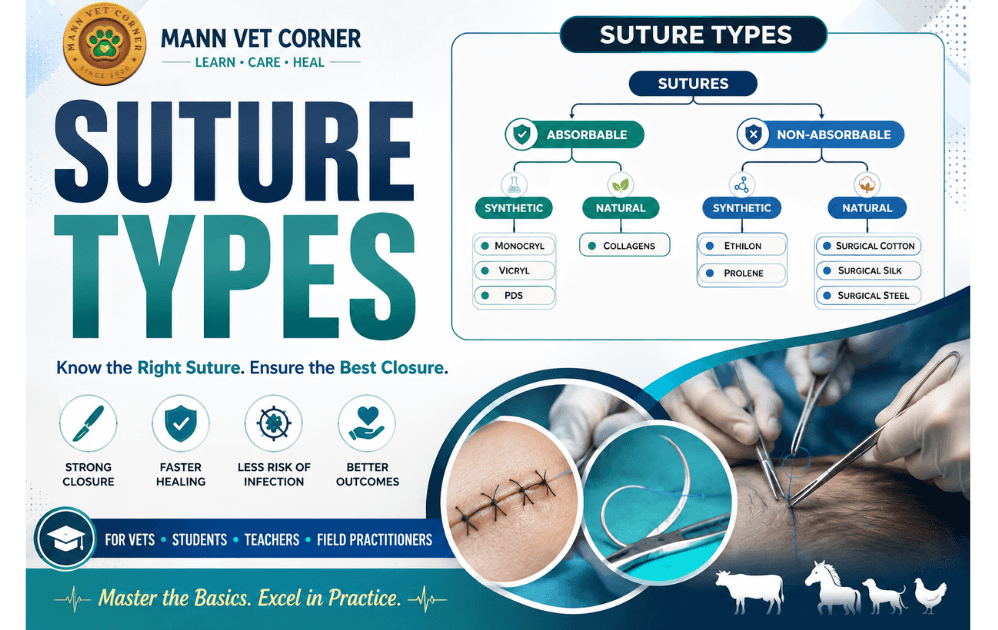
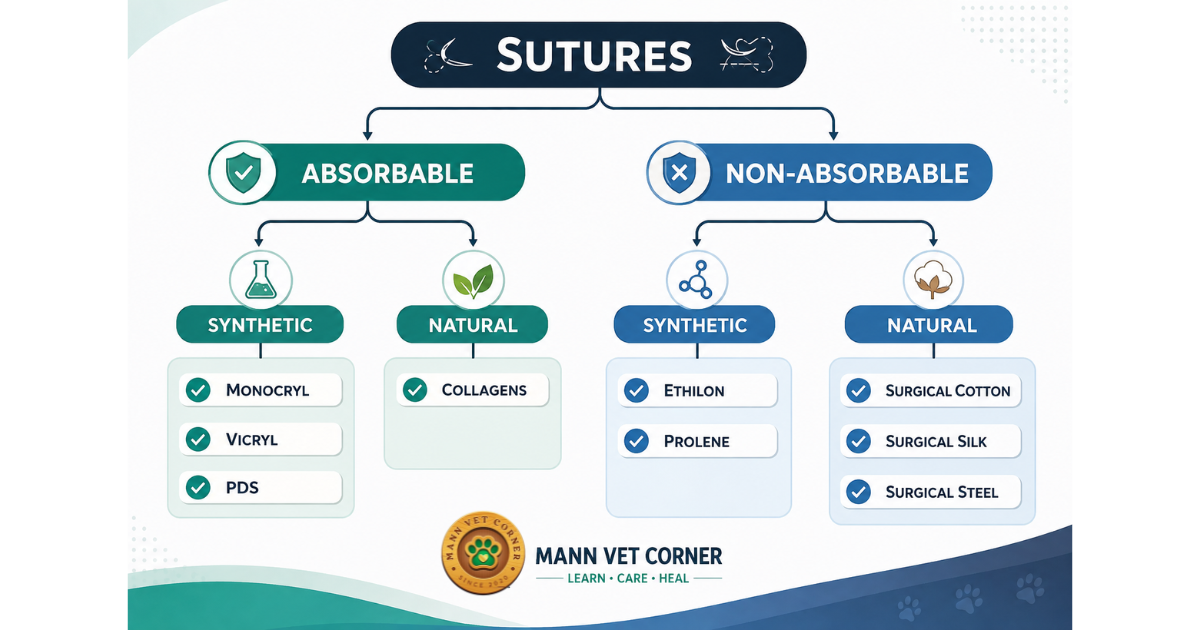
Surgical sutures fall into four categories: (1) Absorbable synthetic sutures like Vicryl and Monocryl, (2) Absorbable natural sutures like catgut, (3) Non-absorbable synthetic sutures like nylon and prolene, and (4) Non-absorbable natural sutures like silk. Selection depends on wound depth, location, and healing requirements.
Absorbable Surgical Sutures: Types, Timeline & Clinical Use
Absorbable sutures break down naturally through enzymatic hydrolysis or tissue absorption over weeks to months. This eliminates the need for suture removal, making them ideal for internal closures, pediatric wounds, and patients unable to return for follow-up appointments.
1. Vicryl (Polyglactin 910): Braided Synthetic Absorbable Suture
Material Type: Braided synthetic polymer | Absorption: 56-70 days | Tensile Strength: 75% at 2 weeks, 50% at 3 weeks | Uses: Soft tissue, muscle layers, fascia, oral surgery | Advantages: Good knot holding, minimal inflammation | Disadvantages: Slightly higher infection risk in contaminated wounds
2. Monocryl (Poliglecaprone 25): Monofilament Absorbable Suture
Material Type: Monofilament synthetic | Absorption: 91-119 days | Tensile Strength: 50-60% at 1 week | Uses: Skin, subcutaneous tissue, dermatology, pediatrics | Advantages: Smooth passage, excellent cosmetic closure, low infection risk | Disadvantages: Lower initial tensile strength
3. PDS (Polydioxanone): Long-Acting Absorbable Suture
Material Type: Monofilament synthetic | Absorption: 180 days | Tensile Strength: 90% at 2 weeks, 80% at 4 weeks | Uses: Deep fascial closure, muscle layers, abdominal wall | Advantages: Longest strength retention, excellent for deep closures | Disadvantages: More expensive
4. Catgut (Plain & Chromic): Natural Absorbable Suture
Material Type: Natural collagen fiber | Absorption: Plain 7-10 days, Chromic 14-21 days | Uses: Mucosal tissues, fast-healing soft tissues, oral surgery | Advantages: Excellent tissue compatibility, natural material, minimal scarring | Disadvantages: Unpredictable absorption, higher infection risk
Non-Absorbable Surgical Sutures: Permanent Wound Closure Options
Non-absorbable sutures remain indefinitely in tissue unless surgically removed. They maintain permanent tensile strength, making them essential for high-stress areas like vessel anastomosis, orthopedic repairs, and skin closure requiring long-term support.
1. Nylon (Ethilon): Monofilament Non-Absorbable Synthetic
Material: Polyamide | Tensile Strength: Permanent | Color: Clear or black | Uses: Skin closure, external wounds, facial repairs | Advantages: Smooth passage, excellent knot security, ideal for cosmetic work | Disadvantages: Requires removal after 7-10 days
2. Prolene (Polypropylene): Monofilament Non-Absorbable
Material: Polypropylene | Color: Distinctive blue | Tensile Strength: Permanent | Uses: Vascular surgery, cardiovascular procedures, blood vessel repair | Advantages: Non-reactive, excellent for vascular work, highly visible | Disadvantages: Lower knot security, requires special tying technique
3. Silk: Braided Natural Non-Absorbable Suture
Material: Natural protein fiber | Tensile Strength: Excellent, permanent | Uses: General surgery, drain closures, maxillofacial surgery | Advantages: Superior knot security, excellent handling, reduced slippage | Disadvantages: Higher infection risk in contaminated wounds
4. Stainless Steel: Wire Non-Absorbable Suture
Material: Surgical grade stainless steel wire | Tensile Strength: Highest of all sutures, permanent | Uses: Orthopedic bone repair, sternum closure, cardiac surgery | Advantages: Maximum strength, high-stress areas, no absorption | Disadvantages: Difficult to place, requires removal by cutting
Suture Structure: Monofilament vs. Braided (Multifilament)
Monofilament Sutures: Single-Strand Construction
Monofilament sutures are made from a single continuous strand. They offer lower drag through tissue (smoother passage), reduced bacterial colonization due to fewer crevices, and minimal inflammatory response. Ideal for skin closure, vascular repair, and cosmetically-sensitive areas. Requires proper tying technique as they have lower knot security than braided.
Braided (Multifilament) Sutures: Multi-Strand Construction
Braided sutures are made from multiple woven strands, offering superior handling and knot-holding ability. They are more flexible and easier to tie securely than monofilament. However, they have slightly increased infection risk in contaminated wounds due to capillary action drawing bacteria along suture lines. Ideal for internal repairs and situations requiring strong knot security.
Quick Comparison: Absorbable vs. Non-Absorbable Sutures
ABSORBABLE SUTURES: Breakdown timeline 7 days to 6 months | No removal needed | Mild to moderate inflammatory response | Best for internal closures, pediatrics, fast-healing tissues | Generally higher cost NON-ABSORBABLE SUTURES: Permanent retention | Removal required | Minimal to absent tissue reaction | Best for skin closure, vascular repair, high-stress areas | Generally lower cost
How to Select the Right Suture: Clinical Selection Guide
1. Tissue Type & Healing Timeline
Fast-healing tissues (mucosal, oral): Choose rapidly absorbing sutures like plain catgut (7-10 days) | Medium-healing tissues (skin, subcutaneous): Select sutures absorbing in 2-4 weeks (Monocryl, Vicryl) | Slow-healing tissues (fascia, deep muscle, bone): Use long-acting sutures retaining strength 8+ weeks (PDS) | Vascular and orthopedic: Non-absorbable permanent sutures (nylon, prolene, steel)
2. Infection Risk & Wound Contamination
Clean wounds: Braided sutures acceptable for better knot security | Contaminated/infected wounds: Monofilament preferred | High infection risk: Non-absorbable monofilament with early removal | Vascular repairs: Non-absorbable to reduce thrombosis risk
3. Tensile Strength Requirements
High-stress areas (joints, tendons, bone): Non-absorbable permanent sutures | Moderate stress (fascial closure, muscle): Long-acting absorbable (PDS) or non-absorbable | Minimal stress (subcutaneous, mucosal): Rapidly absorbing sutures acceptable
4. Cosmetic Considerations
Visible wounds (face, neck, arms): Monofilament for minimal scarring (Monocryl, nylon) | Sub-clinical closure: Absorbable braided acceptable (Vicryl) | Sensitive skin: Minimally inflammatory monofilament (Monocryl, prolene)
Frequently Asked Questions About Surgical Sutures (FAQ)
Q1: Do absorbable sutures hurt or itch as they break down?
Most patients experience minimal discomfort. Some report mild itching or slight pulling as sutures dissolve. Notify your provider if you experience severe pain, excessive itching, or signs of infection (redness, swelling, warmth).
Q2: How long do non-absorbable sutures need to stay in place?
Timeline varies by location: Face/scalp (3-5 days), hands/feet (7-10 days), trunk (7-10 days), joint areas (10-14 days). Internal non-absorbable sutures often remain permanently unless causing complications.
Q3: What happens if a suture breaks or tears during healing?
Minor tears may not affect healing if most of the suture line is intact. Contact your surgeon immediately if the wound separates or you notice increased drainage, as additional closure may be needed.
Q4: Can sutures cause allergic reactions?
True allergic reactions are rare. Silk and natural materials carry higher risk than synthetics. Synthetic absorbable (Vicryl, Monocryl, PDS) cause minimal allergic response. If experiencing hives, excessive itching, or swelling, inform your medical team immediately.
Q5: Are dissolvable sutures better than traditional sutures?
Neither is universally better. Absorbable sutures eliminate return visits and removal discomfort but may trigger mild inflammation. Non-absorbable sutures provide superior knot security but must be removed. Selection depends on wound type, location, and patient factors.
Q6: How do I care for a wound with absorbable sutures?
Keep the wound clean and dry. Gently wash with soap and water; pat dry. Apply prescribed antibiotic ointment if directed. Avoid soaking, swimming, or vigorous exercise. Watch for signs of infection: redness, swelling, drainage, or fever.
Q7: Can sutures affect imaging studies (X-ray, MRI)?
Stainless steel sutures can cause artifacts on MRI, so inform your radiologist. Most synthetic sutures (Vicryl, Monocryl, PDS, nylon, prolene) do not interfere with imaging. Silk and catgut are also MRI-safe.
Suture Grading & Standardization: USP Standards
The United States Pharmacopeia (USP) establishes standardized grading for all surgical sutures. Sizes range from 10-0 (finest, 0.1mm) to 5 (thickest, 5mm). Healthcare facilities use USP-graded sutures to ensure consistency, quality, and predictable performance. Selection also follows institutional protocols, surgical guidelines, and individual surgeon experience.
Conclusion: Choosing Surgical Sutures for Optimal Wound Healing
Understanding surgical suture types—absorbable vs. non-absorbable, monofilament vs. braided, and their specific applications—is essential for healthcare professionals and informed patients. The choice between Vicryl, Monocryl, PDS, nylon, prolene, silk, and stainless steel depends on tissue type, healing timeline, infection risk, tensile strength needs, and cosmetic goals.
Absorbable sutures (Vicryl, Monocryl, PDS, catgut) eliminate removal visits and suit internal closures, pediatric surgery, and fast-healing tissues. Non-absorbable sutures (nylon, prolene, silk, steel) maintain permanent strength and excel in high-stress areas and external skin closure.
Whether undergoing minor dermatologic procedures or major surgical repair, your medical team selects sutures that optimize healing, minimize infection risk, and achieve the best functional and cosmetic outcomes. Ask your surgeon which suture material they are using and why—understanding your wound closure strategy supports better self-care and faster recovery.




Leave a Reply