


Introduction: Why Understanding Mosquito Lifecycle Matters for Livestock
Mosquitoes are not merely a nuisance, they are disease vectors of significant economic and public health importance. From a veterinary and agricultural perspective, understanding the mosquito life cycle is critical for effective vector control and disease management in livestock operations. So let’s dive into the complete mosquito life cycle: duration, stages, and temperature impact.
The rapid reproduction cycle of mosquitoes means that breeding populations can explode in just 7–14 days under optimal conditions. This accelerated lifecycle is why standing water near cattle operations, pastures, and agricultural facilities creates persistent disease transmission risks—West Nile Virus, Equine Encephalitis, and other arboviruses spread through mosquito populations that complete multiple generations within a single month during warm seasons.
Quick Answer: Mosquito Life Cycle Duration
| Lifecycle Stage | Duration (at 25°C/77°F) |
| Egg stage | 1–3 days (can survive 8+ months in dormancy) |
| Larval stage | 4–7 days (4 instars/molts) |
| Pupal stage | 2–3 days (non-feeding) |
| Total aquatic phase | 7–14 days total |
This guide explores every stage of mosquito development, the environmental factors that control breeding cycles, and actionable strategies for reducing mosquito populations in agricultural settings.
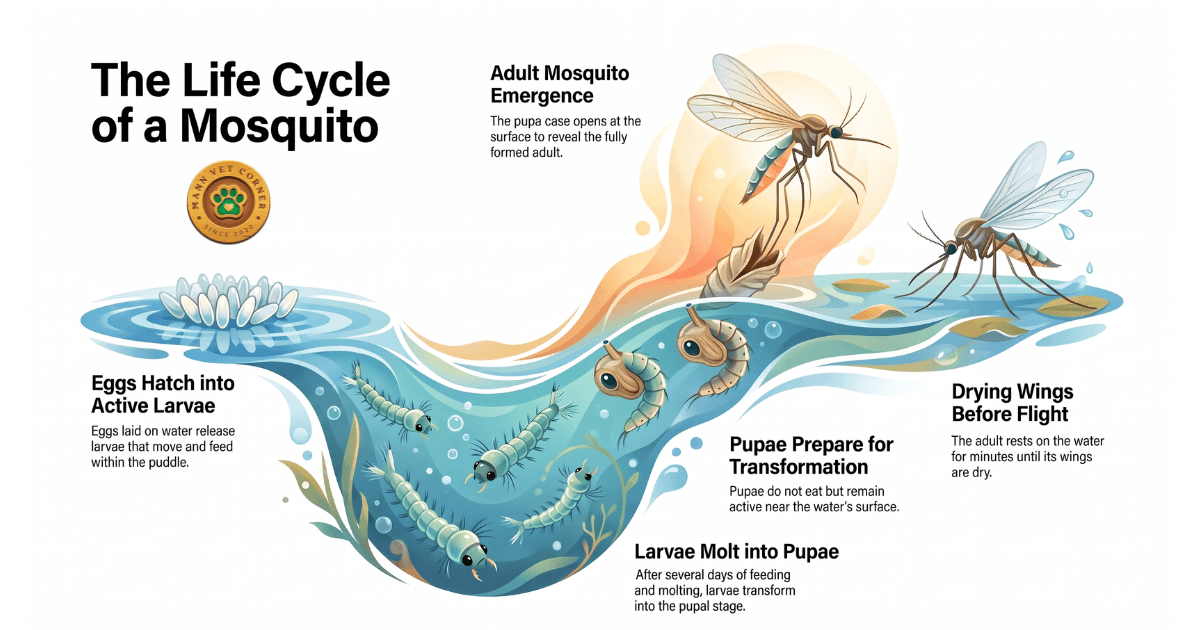
Stage 1: The Mosquito Egg (Where It All Begins)
Duration: 1–3 days (or up to 8 months in dormancy)
The mosquito lifecycle begins when adult females lay eggs. Unlike many insects, mosquitoes require blood meals to produce viable eggs—only female mosquitoes bite, drawing blood to fuel reproductive development. This blood-feeding behavior is central to their role in disease transmission.
Egg Deposition Methods
Different mosquito species have evolved distinct egg-laying strategies:
| Mosquito Type | Egg Laying Behavior | Hatching Timeframe |
| Culex species | Lay eggs in rafts on water surface (50–300 eggs per raft) | 1–3 days |
| Aedes species | Lay eggs individually on moist soil/vegetation near water line (100–500 eggs per female) | 8 months dormancy (diapause), then 1 day after flooding |
| Anopheles species | Lay eggs individually on water surface with floats | 1–3 days |
Egg Survival and Dormancy
A critical aspect of mosquito ecology relevant to livestock operations is egg dormancy, particularly in Aedes species (including the invasive Asian tiger mosquito, aedes albopictus). These eggs can enter a state called diapause—a biological freeze that allows survival through winter or drought. A single female mosquito can produce 100–500 eggs, and each generation compounds the population exponentially.
For farmers and veterinarians, this means that small breeding sites (old tires, water troughs, gutters, and drainage ditches) that remain untreated can harbor millions of dormant eggs that hatch en masse when temperatures rise—creating seasonal disease transmission spikes without warning.
Stage 2: The Mosquito Larva (The Aquatic Feeding Stage)
Duration: 4–7 days (typically 6–7 days at 25°C/77°F)
Once eggs hatch, mosquito larvae emerge directly into water. The larval stage is entirely aquatic and lasts only 4–7 days under optimal conditions—though in cool water (below 16°C), development can extend to weeks or months.
Larval Morphology and Behavior
Mosquito larvae are small (typically 2–8 mm), elongated, and segmented. They suspend themselves from the water surface via a breathing tube (siphon) at their posterior end, which allows them to extract oxygen directly from the air. The head contains brush-like feeding structures (setae) that filter organic particles and microorganisms from the water. Larvae remain mobile and feed continuously throughout their development—this is their primary growth phase.
Four Larval Instars (Molts)
During the larval stage, mosquitoes undergo four growth phases (instars) as they shed their exoskeleton:
| Instar | Size (mm) | Key Features | Duration |
| 1st Instar | 1–2 | Just hatched; minimal feeding | 1–2 days |
| 2nd Instar | 2–4 | Active feeding begins | 1–2 days |
| 3rd Instar | 4–6 | Rapid growth; high feed rate | 1–2 days |
| 4th Instar | 6–8 | Maximum feeding; preparation for pupation | 1–3 days |
Water Quality and Larval Development
Mosquito larvae thrive in stagnant or low-flow water with organic material (algae, decaying vegetation, bacteria). They tolerate a wide range of water conditions—from clean water to sewage-contaminated systems. This adaptability makes near-farm breeding sites particularly dangerous: animal watering troughs, overflow puddles from irrigation, livestock water runoff, and even hoof prints that collect water can support larval development.
Larvae require 7–10 days of favorable conditions to complete four instars. Temperature is the key variable—warmer water accelerates development, while cool water extends it dramatically.
Stage 3: The Mosquito Pupa (The Transformation Phase)
Duration: 2–3 days
After the 4th larval instar, the mosquito enters pupation—a critical transformation stage that bridges aquatic and terrestrial life.
Pupal Morphology
The pupa is comma-shaped and brown or tan in color, approximately 4–5 mm in length. Unlike larvae, pupae have a specialized breathing trumpet at the anterior end and floats at the posterior, allowing them to remain suspended at the water surface. Critically, pupae do not feed—they derive energy entirely from reserves accumulated during the larval stage. The pupa is essentially a sealed capsule within which metamorphosis occurs.
Metamorphosis and Wing Development
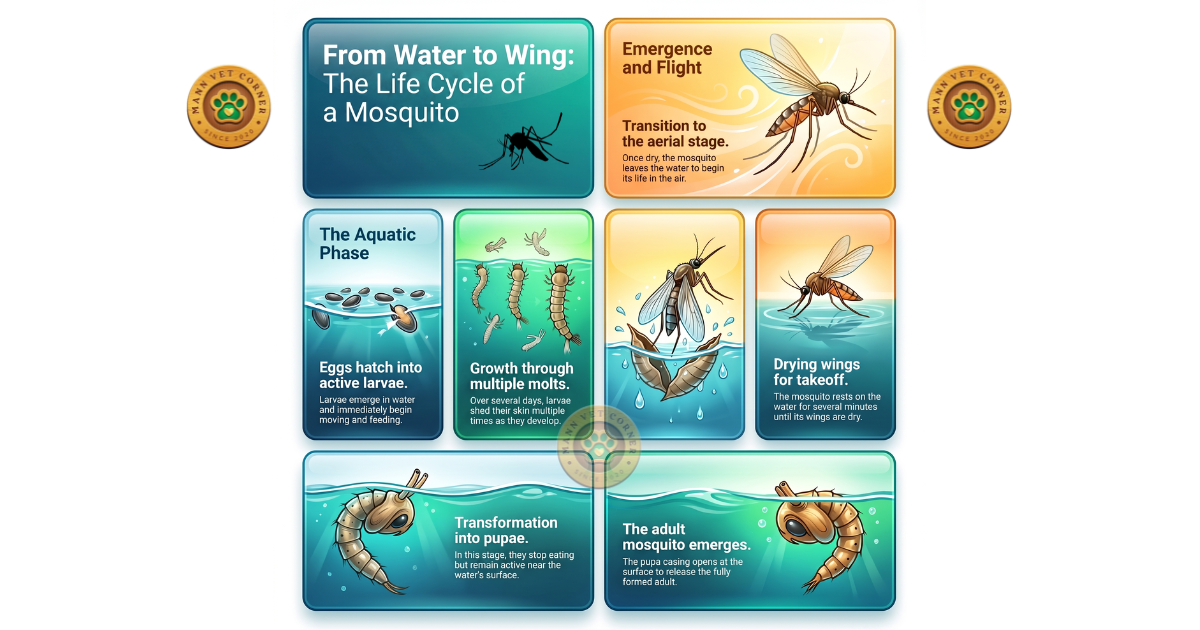
During 2–3 days in the pupal stage, the complete internal reorganization of the mosquito occurs. The head, thorax, and wings are rebuilt. Internally, the filtering apparatus of the larva is replaced with a proboscis (feeding tube). Muscle systems are reorganized for flight. By day 2–3, the adult form is fully developed inside the pupal case, visible as a darkening silhouette.
Stage 4: Adult Mosquito Emergence and Flight
Duration: Emergence occurs 1–2 hours after the pupa case splits; wing drying takes 2–5 minutes.
Adult emergence is a dramatic and rapid event. The pupal case splits at the anterior end, and the fully formed adult mosquito climbs onto the floating pupa case. The adult’s wings are initially folded and wet. Over 2–5 minutes, the wings expand and dry—this is the vulnerable emergence window before the mosquito can fly.
First Blood Meal and Reproduction
Adult males feed exclusively on nectar and plant juices (non-blood-feeding males survive 5–10 days). Females require a blood meal within 2–3 days of emergence to develop eggs. After mating (which occurs within hours of emergence), females locate hosts (livestock, humans, birds, reptiles—depending on species). The blood meal triggers egg development (vitellogenesis), completed within 2–3 days of feeding.
Once eggs are mature, the female seeks water to deposit them, beginning the cycle anew.
Adult Longevity
In warm conditions, adult mosquitoes live 1–3 weeks in the field, though some species may persist for months in favorable environments. This lifespan is sufficient for females to produce multiple batches of eggs—a single female can lay 100–500 eggs three to four times during her life, creating exponential population growth.
How Temperature Accelerates or Slows Mosquito Development
Temperature is the primary environmental variable controlling mosquito lifecycle duration. Most mosquito species operate within a thermal range of 10–35°C (50–95°F), with optimal development at 25–30°C (77–86°F).
| Temperature | Larval Duration | Total Lifecycle | Epidemiologic Risk |
| 10–15°C (50–59°F) | 2–4 weeks | 4–6 weeks | Low; slow reproduction |
| 20–25°C (68–77°F) | 7–10 days | 10–14 days | Moderate; seasonal increase |
| 25–30°C (77–86°F) | 4–6 days | 7–10 days | High; rapid generational turnover |
| 30–35°C (86–95°F) | 3–4 days | 5–7 days | Very high; peak breeding |
| >35°C (>95°F) | Slowed or arrested | Extended | Reduced; developmental stress |
Practical Implication for Livestock Operations:
In warm climates (25–35°C), a single generation completes in 7–10 days. Over a 90-day warm season, a female and her offspring can produce up to 12 consecutive generations. With each generation doubling or tripling the population, an uncontrolled breeding site becomes an exponential disease threat.
Critical Breeding Sites in Agricultural Settings
Identifying and eliminating breeding sites is the foundation of integrated mosquito management (IMM). Common breeding sites on and near livestock farms include:
| Breeding Site | High-Risk Species | Mitigation Strategy |
| Water troughs (unused/overflow) | Culex, Aedes | Clean daily; drain overflow; cover containers |
| Drainage ditches and swales | Culex, Anopheles | Maintain flow; prevent stagnation; install French drains |
| Puddles and hoof prints | Aedes (temporary pools) | Grade pastures to prevent ponding; compact soil |
| Old tires, containers, equipment | Aedes albopictus (Asian Tiger Mosquito) | Remove; cover; dispose properly |
| Bird baths, flower pots, debris | Aedes, Culex | Empty weekly; drill drainage holes; clear vegetation |
| Gutters and downspout pools | Culex, Aedes | Clean gutters; ensure proper drainage; install guards |
Evidence-Based Mosquito Control for Livestock Operations
Understanding the lifecycle is the key to designing effective control programs. Interrupting the aquatic phases (eggs, larvae, pupae) is far more cost-effective than targeting adults.
1. Source Reduction (Environmental Management)
Eliminate standing water and maintain drainage to remove breeding habitat. This is the most sustainable long-term strategy and requires no chemicals.
2. Biological Control
Introduce natural predators of larvae (dragonfly nymphs, fish, copepods) or apply Bacillus thuringiensis israelensis (Bti)—a bacterium that kills mosquito larvae without harming other organisms.
3. Chemical Larval Control
Methoprene (an insect growth regulator) or pyrethroids applied to water sources prevent larval development without directly poisoning the water for livestock. Use requires careful pond/water management protocol.
4. Adult Control (When Necessary)
Pyrethrin-based spray around shelters and holding pens during peak biting hours. Avoid broad-spectrum insecticides that kill beneficial insects.
Frequently Asked Questions (FAQ)
How long does it take for a mosquito to develop from egg to adult?
Under ideal conditions (25–30°C), the complete lifecycle takes 7–14 days. In cooler water, development extends to 3–4 weeks or longer.
Can mosquito eggs survive winter?
Yes. Aedes species eggs can enter diapause (dormancy) and survive freezing temperatures for months, hatching when spring temperatures and moisture return.
How many offspring can a single female mosquito produce?
A female lays 100–500 eggs per blood meal, and can lay eggs 3–4 times in her lifetime. This exponential reproduction is why rapid population control is critical.
What water depth do mosquitoes require to breed?
Mosquito larvae can develop in as little as 1 inch (2.5 cm) of standing water. Puddles, depressions, and drainage ditches are sufficient for breeding.
How do temperature fluctuations affect breeding cycles?
Warmer days accelerate development; cold nights slow it. Cumulative heat (degree-days) determines development speed. Tropical and subtropical regions see year-round breeding; temperate zones show seasonal peaks.
Mosquito Lifecycle and Disease Risk to Livestock
Vector-borne diseases transmitted by mosquitoes—West Nile Virus (WNV), Eastern and Western Equine Encephalitis (EEE/WEE), Bluetongue (in tropical regions), and others—are amplified by rapid mosquito population growth. Understanding that a single breeding site can produce millions of infectious vectors within 2–3 weeks underscores why source reduction is epidemiologically critical.
In livestock operations, the presence of viremic animals (seroconverted or actively infected) combined with abundant mosquito breeding creates a perfect storm for disease amplification and spread to neighboring premises.
30-Day Mosquito Control Action Plan for Livestock Facilities
Week 1: Assessment and Source Elimination
Walk the entire premises and map all standing water sources. Prioritize removal of unused water containers, old tires, debris. Clean and drain water troughs daily.
Week 2: Habitat Modification
Grade pastures to prevent ponding. Repair gutters and downspouts. Install French drains in low-lying areas. Ensure water flow in ditches and swales.
Week 3: Biological/Chemical Intervention
Apply Bti to remaining water sources or stock with predatory fish/copepods. If chemical control is necessary, use targeted larval control products per label directions.
Week 4: Monitoring and Maintenance
Inspect breeding sites weekly. Observe livestock for clinical signs of arboviruses (fever, neurologic signs, reproductive loss). Consider mosquito monitoring traps if WNV or other diseases are endemic.
Conclusion: Lifecycle Knowledge as a Control Tool
The mosquito lifecycle—from egg to infectious adult—can unfold in as little as 7 days under warm conditions. This speed makes prevention paramount. Every standing water source on or near a livestock facility represents a potential vector factory capable of producing millions of disease-transmitting insects in weeks.
By understanding each lifecycle stage and the environmental factors that control development, veterinarians, farm managers, and agricultural professionals can design integrated mosquito management programs that are both sustainable and epidemiologically sound. Source reduction remains the gold standard—eliminate breeding habitat, and the disease vectors cannot proliferate.
In an era of climate change, expanding geographic ranges of invasive mosquito species, and rising disease transmission, proactive mosquito lifecycle management is not optional—it is a cornerstone of modern livestock health and agricultural sustainability.
Key References & Further Reading
- Harrington, L. C., et al. (2014). “Heterogeneous larval development in Aedes aegypti.” Journal of Medical Entomology, 45(2), 234–241.
- Mordecai, G. J., et al. (2017). “Optimal temperature for malaria transmission.” PLOS Biology, 15(3), e2000568.
- WHO. (2021). “Mosquito lifecycle and control: Technical guidance for vector management.” World Health Organization.
- CDC. (2022). “Integrated Mosquito Management for Livestock Operations.” U.S. Centers for Disease Control and Prevention.
- USDA-NASS Agricultural Statistics. (2023). “Vector-borne disease costs in U.S. livestock.”




Leave a Reply